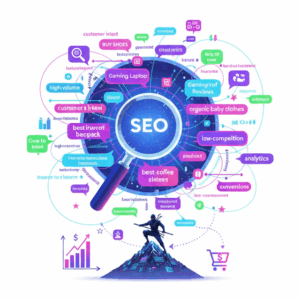
 Keyword research for ecommerce is the foundation of any successful online store’s SEO strategy. It involves identifying the exact words and phrases potential customers use when searching for products like yours. By understanding how your audience searches, you can optimize your product pages, category listings, and blog content to attract high intent traffic that is more likely to convert.
Unlike general SEO, ecommerce keyword research requires a sharper focus on buyer intent. Shoppers are not just looking for information; they are ready to make a purchase. Finding and targeting the right mix of transactional, commercial, and informational keywords helps position your store in front of the right audience at every stage of the buying journey.
When done strategically, keyword research can guide your entire digital marketing approach, from product naming and descriptions to paid ads and content marketing. It ensures that every word on your site works toward one goal: increasing visibility, attracting qualified visitors, and driving more sales.
The primary goal is to identify a mix of keywords that will drive relevant, high-converting traffic to your product and category pages on your e-commerce website. This means focusing on keywords with:
- High Search Volume: Enough people are searching for them to make them worthwhile.
- High Relevancy: The keywords directly match your products and customer intent.
- Moderate Competition: You have a realistic chance of ranking for them.
- Commercial Intent: Users searching these terms are likely ready to buy.
Your customers search differently on Amazon, eBay, and Google. Use multiple platforms for a complete view:
- Google Autocomplete: Enter your main keyword into Google and review the suggested phrases. Focus on prepositions and question-based terms for valuable insights.
- People Also Ask (PAA) & Related Searches: These sections on Google’s results page are excellent for uncovering long-tail and informational keywords ideal for blog or guide content.
- Internal Site Search: Review your e-commerce platform’s search analytics to identify the exact words customers use when they can’t find products. These reveal high-intent keyword gaps worth optimizing for.
- Competitor Product Listings: Study how top competitors and sellers on platforms like Amazon and eBay title their products and write descriptions. Their phrasing often includes proven, high-converting long-tail keywords.
- Customer Reviews: Analyze product reviews and discussions on platforms like Reddit to capture the authentic, benefit-driven language customers use – a rich source for content and keyword inspiration.
Once you have your list of keywords, you need to map them to specific pages on your
e-commerce site.
- Category Pages: Target broader, mid-tail keywords (e.g., “women’s running shoes,” “gaming laptops“).
- Product Pages: Focus on specific product names, model numbers, and highly descriptive long-tail keywords (e.g., “Nike Air Zoom Pegasus 38 women’s running shoes size 7“).
- Blog Posts / Guides: Target informational keywords and long-tail questions (e.g., “how to choose a gaming laptop,” “best running shoes for flat feet“).
By diligently performing
keyword research and mapping, you’ll lay a
solid foundation for your e-commerce SEO efforts, ensuring that every page on your site is optimized to attract the right customers.